Funds created under former Presidents Mwai Kibaki and Uhuru Kenyatta to support women, youth, and persons with disabilities are losing their footing, as new credit programmes championed by the Kenya Kwanza government gain momentum.
The shift shows a growing focus on digital lending initiatives such as the Hustler Fund and the Nyota project, which have rapidly become central to government enterprise financing.
Latest data reveals that the Uwezo Fund and the Women Enterprise Fund (WEF) fell well short of their lending goals in the last financial year.
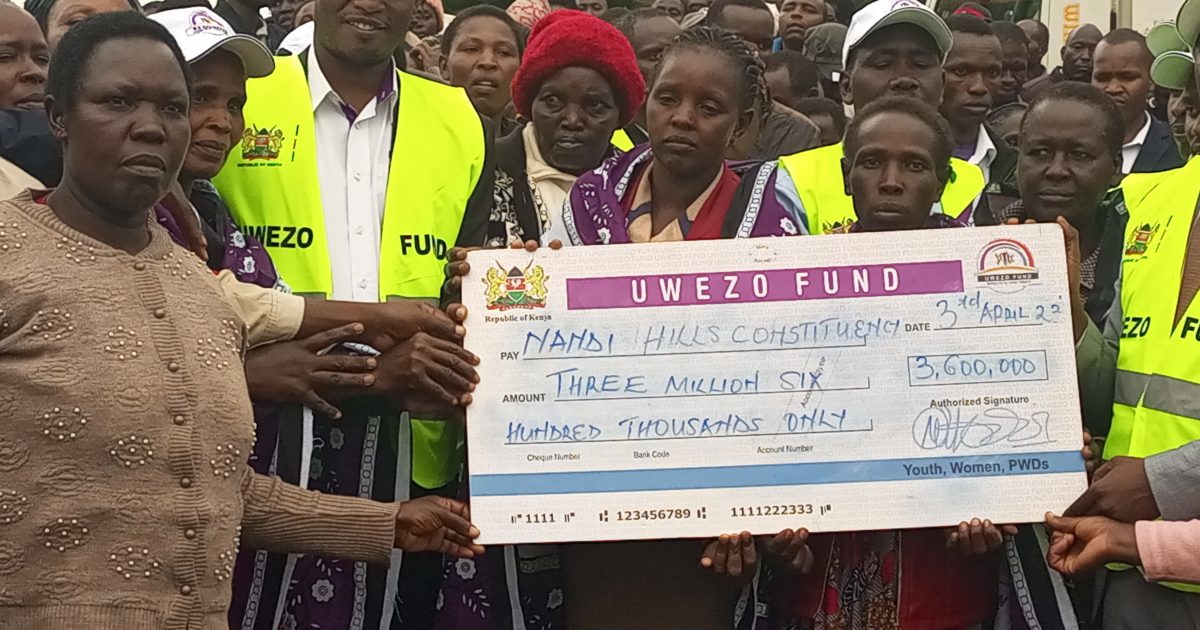
Uwezo Fund disbursed Sh431.4 million for the year ending June 2025, missing its Sh600 million target and reversing the growth seen in 2023-24, when it exceeded Sh500 million following “rigorous sensitisation and relaxation of loaning guidelines” at the grassroots.
The State Department for Micro, Small, and Medium Enterprise Development cited operational delays at the constituency level as the main cause of the shortfall, which slowed loan approvals and distribution.
“The target for the financial year 2024/25 was not achieved as a result of 80 constituencies being dormant, and another 20 not having committees,” the department noted in the 2026 budget proposals.
The Uwezo Fund, established in 2013 during the Uhuru Kenyatta administration while President Ruto served as Deputy President, was designed to offer interest-free loans and skills training through constituency-based structures.
Its reduced activity coincides with the rapid rise of the Financial Inclusion Fund (FIF), better known as the Hustler Fund. By June 2025, the Hustler Fund had disbursed more than Sh72 billion to nearly 26 million Kenyans, up from Sh52 billion in 2023-24 and Sh35 billion in 2022-23, reflecting its dominant role in the current government’s support to small businesses.
Despite this growth, the fund received only Sh14.8 billion from the Exchequer by mid-2025, far below the Sh50 billion initially promised by President Ruto in September 2022, raising questions about its long-term sustainability.
Meanwhile, the Women Enterprise Fund recorded one of its weakest performances in recent years. It disbursed Sh457 million against a Sh2.7 billion target for 2024-25, down from Sh941 million in 2023-24 and Sh1.72 billion in 2022-23.
Launched in 2007 under former President Kibaki, WEF has long been the main government programme for widening women’s access to affordable credit.
The State Department for Gender and Affirmative Action explained that the steep decline followed the suspension of WEF’s digital lending platform due to low repayment rates and rising defaults.
The department added that lending targets were not properly adjusted to match the digital model. As a result, only 12,538 women entrepreneurs benefited from WEF funding, far below the 200,000 target and a sharp drop from 189,550 beneficiaries in 2023-24.